

Tired of Reading About AI? Me Too.
But I keep reading about it anyway

I am tired of hearing about artificial intelligence. Since ChatGPT debuted in late 2022, it feels as though I cannot go a day without being subjected to AI against my will.
Enrolling in law school only made things worse. My law school and its overarching university are not on the same page about AI. UCLA has embraced the new technology. It was the first university in California to offer enterprise-level ChatGPT. The business school hosts an annual Embracing AI summit. Undergraduates are encouraged to use AI to assist with their learning.
But in the law school, AI remains controversial. For example, all first-year law students complete a year-long Legal Research and Writing (LRW) course. In the fall semester, we were instructed that any suspected use of AI to complete our final paper would result in a report of an academic violation — serious business for any student, but doubly so for law students, whose academic violations are reported to the state bar examiners.
The prohibition made sense to me. I have to learn how to write like a lawyer if I am going to become one. But a rule that seemed simple on its face became more complex the longer I worked on my paper. Like most law students and practicing attorneys, we have access to the two main legal databases, Westlaw and LexisNexis. Both platforms offer AI-assisted research.
These tools do not generate text that could go in a paper, nor do they edit previously written work. But they do greatly streamline the time-consuming process of legal research. Would the use of WestLaw’s AI Deep Research have constituted cheating? What about uploading a finished paper to a more generic AI platform like Gemini or ChatGPT purely for grammar and spelling edits?
In case anyone from UCLA or the California State Bar is reading, I never tried. I was far too scared that I would accidentally do something prohibited.
However, when we returned in the spring for the second half of LRW, we were told that not only was the use of AI no longer cheating, we were required to use AI as part of our research1. If we did not wish to use AI, we were required to submit a statement of ethical objection.
To make matters even more confusing, the school had also granted us accounts for Harvey. The platform is a more complete AI dedicated entirely to legal issues, as if ChatGPT had only read law school casebooks and the Constitution.
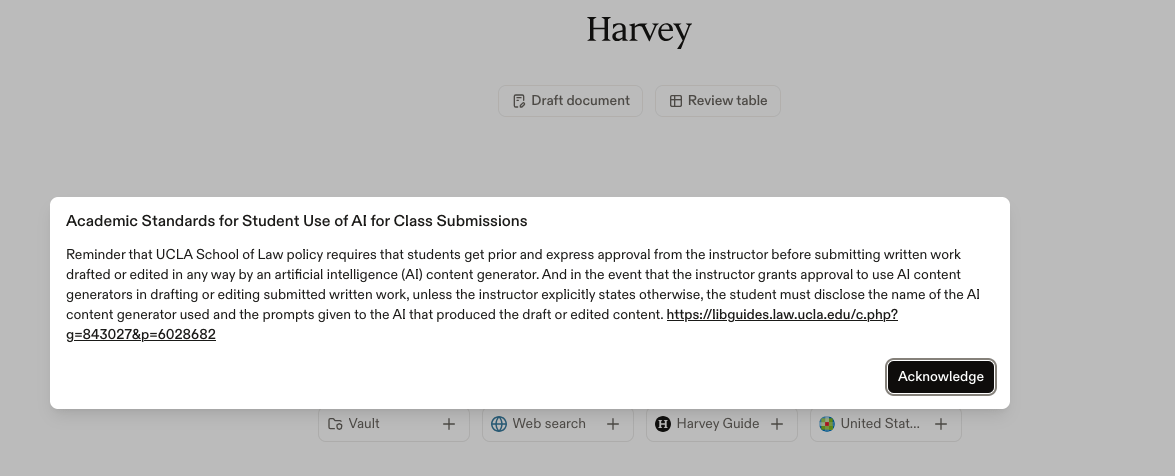
But the announcement of semi-mandatory use of AI was not made in a vacuum. The class of 2028 was also informed that, for the first time in the law school’s history, we would be required to complete an in-class graded writing assignment before we finished LRW. While never officially confirmed by the administration, faculty and students knew the real reason for the surprise assignment: rampant use of AI by students when writing the fall semester’s paper.
The mixed messaging is overwhelming. We cannot use AI to complete assignments, except when it is required. The school will report you to the bar for using AI when it is not allowed, but the school will also get you hooked on legal AI tools so you encourage your future law firm to purchase them. Meanwhile, the state’s flagship law school is banning AI for nearly all work beginning this fall. And if you graduate, pass the bar, and submit an AI-authored briefing to a court, you are risking your law license.
After close to four years of mainstream discourse and an academic year steeped in AI discussions, I still cannot make up my mind about how I feel about the technology. It seems clear to me that we are not on the verge of true artificial intelligence, like what is shown in the movies Her or Terminator.
And I have a lot of ethical concerns about AI that turn me off from embracing it further. Corporations are evangelizing AI to excuse job cuts, especially of entry-level roles. Each 100-word AI prompt uses the equivalent of a bottle’s worth of water, and AI is on track to require more electricity than one-fifth of the entire United States by 2028. Disinformation, which was already a major problem on social media, is now harder to detect than ever thanks to increasingly accurate deepfakes. And AI is still impossible to trust.
Each of these issues on its own would be enough to give me pause about adopting the new technology. However, my biggest hang-up with AI is its roots in piracy.
I am not a copyright aficionado. My heart does not weep for Warner Bros. or Penguin Random House. But something will never sit right with me about the world’s largest tech firms building their most valuable products on the backs of every newspaper article, book, script, and blog post ever published to the internet without paying a dime of compensation.
Meta, currently the tenth-most valuable publicly traded company in the world, ripped the entire Library Genesis dataset to train its AI model. For those who have not been a student in the last 15 years, Library Genesis, or LibGen, is the most popular site for pirating textbooks. It also contains millions of novels, nonfiction books, and scholarly articles.
When I was a sophomore, one of my dormmates torrented a season of the show Suits. He was warned the next day by the university’s IT department that, if he did so again, he would have his access to the school’s internet revoked for the remainder of his time as a student. The RIAA and MPAA spent much of the early 2000s suing teenagers and grandmothers for $100,000 per song for Napster-style piracy. But when Meta or OpenAI or Anthropic do the same thing, their share prices (or projected IPO valuations) climb higher and higher.
Meanwhile, corporate leaders want to replace creative roles with AI-generated text and imagery. The writers and artists whose jobs are being taken away created the work upon which AI models were built. In the back of my mind for my final year as a communications manager was the needling realization that the communications field may not survive long enough for me to build a career.
There is nothing more human than creation for creation’s sake. I would rather read the worst human-authored fan fiction imaginable than an AI-generated novel. A kindergartener’s finger-painting has more magic to me than an AI-generated movie.
So I resisted using AI for as long as I could. Working at a media outlet that covered environmental issues made AI avoidance easy, as it is hard to envision a more AI-opposed workplace.
But it is clear to me now that AI is here to stay. Its functions have been needlessly shoved into every facet of our lives, and it is far from the panacea for all our problems Silicon Valley wants it to be, but it is not going away. The perfect comparison is the internet.
In the late 1990s, as the internet reached the general population, Silicon Valley and Wall Street lost their minds over the new technology’s capabilities. Any company remotely connected to cyberspace could IPO and see its market cap double overnight.
Finally, in 2000, the bubble burst. Companies like Pets.com and Kozmo.com went bankrupt. Even survivors limped along for years, with Amazon’s share price not stabilizing above pre-2000 levels until 2010. But the internet as we know it never went away. And, 26 years later, it is more used than ever.
Something similar is coming for AI. I do not know how or when, but the bubble will burst. A few AI firms will survive. The technology will persist in a more limited way. Integrations that never made sense, like Carl’s Jr. foisting AI on its unsuspecting customers at the drive-thru, will become too expensive or too brand-toxic to continue.
And, like the internet, the core infrastructure of AI will continue to spread. Younger generations will laugh about the idea of there being a time before AI was available. Eventually, the iPhone of AI will debut, and the way we interact with the technology will change again.
The inevitability of AI has caused me to hold my nose and learn to use AI to a basic degree. I will forever struggle to trust open-ended models like ChatGPT and Gemini to avoid hallucinations, but I find the closed models like NotebookLM or a locally run version of Claude very helpful, as I know their outputs are only built on the inputs I have supplied.
You have my pledge as my readers that nothing I publish will ever be AI generated, but I have begun asking Gemini to scan my drafts for any grammar or spelling errors. The big benefit of an AI editor over standard spellcheck is that it explains the grammar mistakes it spots, helping me to avoid repeating them in the future.
In simpler terms, I am embracing AI as a tool — and nothing more. It is not a crutch for thinking critically nor a replacement for doing my readings or writing my papers. I will also admit to shuddering a little when I see students in lectures who have Claude or ChatGPT open and ready in case they are called on. But their choices do not affect me, and I need to let them be. I am sure there were students in generations past who rolled their eyes at the early adopters of the internet who were quick to Google a professor’s questions during lectures.
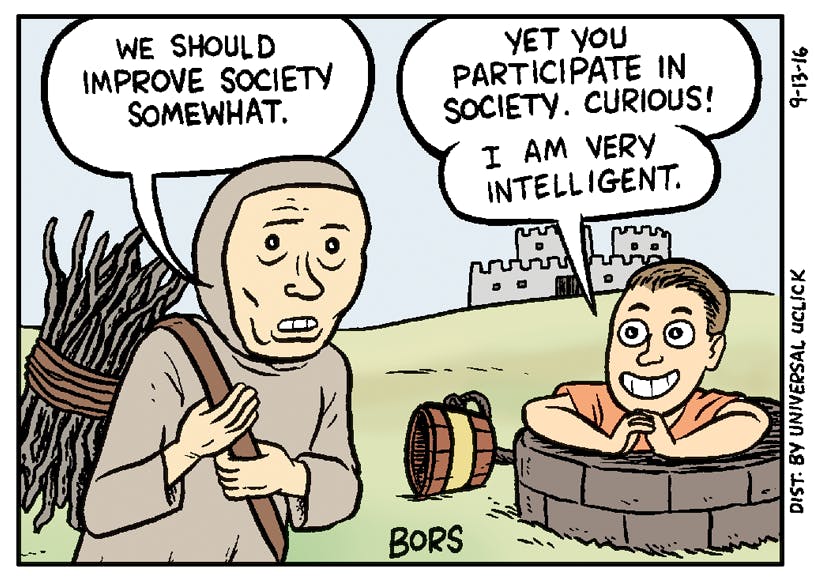
I will never feel great about using AI. But I also do not feel great about using a MacBook made in brutal factories in Shenzhen or riding in an Uber after the company spent hundreds of millions of dollars to avoid having to pay its drivers a real wage. We should improve society somewhat, and yet I participate in society. Curious!
Ending a piece of writing by hand waving at capitalism is sophomoric and lazy. But sometimes the problems we face are of such an overwhelming magnitude that I do not know what else to do. After all, this piece might be sanctimonious and meandering, but at least it was written by a human being. That has to count for something.
Things I Recommend This Week
Why Utah Adoption Agencies Are America’s Most Exploitative | The Cut
Why Wikipedia Can’t Explain Math | Tastemaker Design (YouTube)
An Oral History of Too Many Cooks, Adult Swim’s weirdest experiment ever | Inverse
Is It Ethical To Be A Billionaire In Neopets? | Defector
The Night 17 Million Precious Military Records Went Up in Smoke | Wired
How are you grappling with AI? Do you use the technology in your personal or professional life? I am deeply curious, so please leave a comment and let me know.
I hope the unofficial start of summer is off to a great start!
For first-year law school graded papers, the research process is evaluated as part of a student’s overall grade. A final submission includes the paper, a research log, and a list of works cited.
Very interesting to hear about the difference in AI philosophy under UCLA's umbrella (sounds like it's more aligned now). It does feel like we are being force-fed AI-centered content at every turn right now. At work, there's several emails a week asking how we are using AI to improve our work efficiency and capacity and imploring us to spend our free time innovating within our roles. In the news, we're either hearing about Anthropic's newest endeavor or hearing about mass layoffs with AI as the scapegoat (especially as an SF resident working in tech). It can be exciting to think about its potential, but I'm personally a bit of a cynic at the moment, partially as a result of being overwhelmed by the constant stream of new info.